
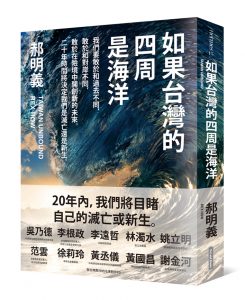

Taiwan Unbound
by Rex How
“We must dare to be different from the past, dare to be different from the other side, and dare to create a new future in the midst of danger. Twenty years of time will determine whether we will be destroyed or reborn.”
“The accounting law being sent to the Legislative Yuan with missing words, The Office of the President allowing a mentally disturbed woman to walk up to the fifth floor, the prolonged scandal of plasticizer and cooking oil, Taoyuan International Airport allowing a live cat in luggage to pass security, the Apache incident with the socialites, and the Cross-ministerial Committee’s efforts in improving the economy but achieving the opposite results… What do all these news events tell us?”
The book opens with a foreword written by Rex How, explaining the origin of his book. Then, at the beginning of the first chapter, the author brings out several seemingly unrelated news events and ends by summarizing his observation of the biggest problem that Taiwan is facing: “The government operations have been paralyzed and the administration has collapsed.”
As an important figure in the publishing industry, Rex How became well-known two years ago when he “fired the first shot” in the Anti-Black Box Curriculum Movement. Taiwan Unbound is a book he wrote in the past two years after he resigned from his position as a National Policy Advisor due to the protest against the policy changes. It is a book to reflect on the reality and future of Taiwan.
How says that Taiwan has not only come to the age of media, but also to an age of civic action. An age where everyone is a great reasoner and analyses the root causes of their own society’s problems and looks to improve them.
The book not only combines How’s own vision and long-term observation of Taiwan’s Cross-Strait relations, but also interviews many people from different age groups, especially those in their 20s and 30s. The book reflects his strong arguments. Similar to detective fiction, there are clues and patterns that gradually reveal the root causes of the internal and external problems that have plagued the Taiwanese people for years.
Rex How says, “When many people hear the title of the book Taiwan Unbound, they all ask ‘We are surrounded by oceans, aren’t we?’ ”
Geographically yes, he says. But psychologically and consciously, we are not. Due to several reasons, Taiwan is clearly in the middle of the ocean, but has turned its back to it for a long time. This is leading us to forget the adventure of exploring the oceans, and we are stuck with the conservative mentality of village farming. We cannot see our resources despite being in the midst of abundance. Instead, we are creating more and more destruction along the way that will eventually lead to trouble, or even despair.
How says he has heard many people around him feel pessimistic about the current situation in Taiwan. He says that the recent outbreak of problems in Taiwan is still a small matter, the most serious issue is that Taiwan has been suffocating itself with the accumulation of all those problems and old habits. Therefore, he believes that the next twenty years will not only be a critical period for Taiwan to witness its own demise, but also its possible rebirth.
According to Rex How, to be brave is the fundamental belief of change: “Dare to be different from the past, dare to be different from the other side, and dare to create a new future in the midst of danger.”
This book is divided into three parts:
Part I: “The Sum of Fears”
The author summarizes the political, economic and social problems that have accumulated over the years and explains why it’s about to explode. These fears come from:
- No matter who will be in power, the person will have to face the challenges of a collapsed and non-functional government;
- An economy that is too old-fashioned and unimproved;
- From economic activity to housing, young people’s hopes are overshadowed by the government and the older generations;
- Taiwan is in the middle of the ocean, but it has depleted its own resources and became a “fishless sea;”
- The nuclear waste that has nowhere to go has reached a critical and dangerous stage;
- Both the Kuomintang and the Democratic Party lack initiative in shaping the cross-strait policy and as a result, putting both sides in danger.
- Threats of the present and future Cross-Strait Service Trade Agreement as well as other unnoticed issues.
The author wrote in the first part: “Conclusion 1: An independent ATM,” pointing out that political party figures have repeatedly incited independence and aggravating the blue-green struggle due to their laziness. Political parties use independence as an ATM when they run out of cards to play. It is an attempt to divert anger from their own incompetence by creating confrontation through the supporters’ dislike of the other side’s color.
In addition to the direct interview with the presidential candidates, Rex How called on the political party figures to change. He also reminded that this kind of apparently confrontational thinking is in fact a land-based thinking. However, if you switch to an ocean-based thinking: “Although there are different topographies of deep grooves and shallow beaches, everything is contained under the wide surface of the sea. Different areas of the sea have different color variations but these waters are not separated nor confronting each other. They coexist and communicate with each other, only showing different colours with the change of time and light.”
Part II: “The Sum of Hopes”
Based on the author’s observations and interviews, he concludes that Taiwan is also bursting with new hopes. These new hopes lie in:
- There are three new types of talented people needed in the future. They will use the tools of digitization and internationalization to participate in social “action” and community “collaboration” to bring new energy into Taiwan.
- Instead of relying on the government, the civil society must take the initiative to break through the barriers. They must dare to take a different path by promoting the emergence of a new economy and industrial upgrading. Many of them will be young people.
- Having six times more young people with immeasurable enthusiasm to engage in civic movements of all kinds than five years ago. They are into politics, education, the sea, environment, rural areas, and national security. They aim to transform their own societies and environments with their own hands, with the companionship of their friends.
- If Taiwan can get rid of the distorting mirror of independence and look at the other side as a mirror, we will find that this mirror can help us experience three tests. The first test is wealth. A test of how we can transform our mindset and habits of wealth generation, instead of relying on the money we earn from tourists and cheap OEMs.
- Taiwan’s second test is to get rid of the independence mindset and to see its key hub position in the Pacific Ocean, and to find out the angle to get along with the other side by dynamic balance. Get to know our position in the Pacific Ocean and use a dynamic balance to find the angle of dealing with the other side.
- Taiwan’s third test is to realize and practice the value of civic action in a democratic society to take itself to the next level. In this way, while the other side is showing the world the ultimate “usefulness”, Taiwan can show the other side the “usefulness of the useless.” By utilizing this “usefulness of the useless,” the other side would feel that there is something to learn from us. The author says: “When we say that the nationalist ideology of the other side is too narrow-minded, we must first break away from the logic of the sovereign state of the Westphalian system. In this era of global community, we should open our hearts and minds to the world and solve problems together.”
- In addition to the collapse of the administrative system itself as described in Part I of this book, many problems in Taiwan have erupted because of the Legislative Yuan, the defending of legislative and executive powers, and the confusion over the identity of those who govern the country. The time has come for a constitutional amendment initiated by citizens not by political parties. It is necessary to clarify the system of government to change the way legislators appear and the composition of the Legislative Yuan. Since the constitutional amendments were led by the Kuomintang and the Democratic Progressive Party in the past, both of them were motivated by the selfish interests of their parties. The time has come for the people to act as we have been focusing on the smallest details instead of touching on the major points of the constitution.
- The author writes in the conclusion of the second part, “The solver should have respect for the questioner.” He explains why after two years of reflection, he finally decided to start the book in mid-March this year after reading a detective fiction novel. “We should expect ourselves to be a big reasoner, and the time has come to find a way out for this drama. The only way to solve such mysterious and difficult problems is to honor the hearts of all those who created them. Without them, we would not have these problems to solve.” Rex How says this is the only way to treat the solution as an amazing game. Only then, an answer that could not have been possible would appear.
Part III: “Case Study: An Analysis of a Citizen Action Plan”
In the third part of the book, How reviews and organizes his journey from the Anti-Black Box Curriculum Movement, to the Sunflower Movement, to the period before the November 29th’s Elections. “Civic action requires discourse and power of words.” The author says, “I hope to share my experience on the Anti-Black Box Curriculum Movement as a case study for everybody’s reference.” How has compiled more than ten published articles, each with “background information” to explain the motivation and focus of writing at that time. He also added a section of “subsequent development” to explain what happened after this article so that it could be used as a reference for other citizen activists.
Solvers should have respect for the questioner.
The answer would only appear when we face different challenges and dangers.
For a complete festival schedule, please subscribe the calendar or download the pdf.
Google Calendar
Click the icon to add to your Google calendar and receive any updates.
iCal Calendar
Use this url to add to your iCal calendar.
https://bit.ly/3k17dOq
pdf Format
Press the icon to download the complete program schedule.
Join Our Newsletter
For Early Announcements And More
Contact Us
Performance / Vendor / Sponsorship Opportunities
© 2021 Taiwanese Canadian Association of Toronto